Subterranean termite treatment in Nashville addresses the specific vulnerability of regional architecture, where high humidity along the Cumberland River basin accelerates wood rot and subterranean activity. Properties…
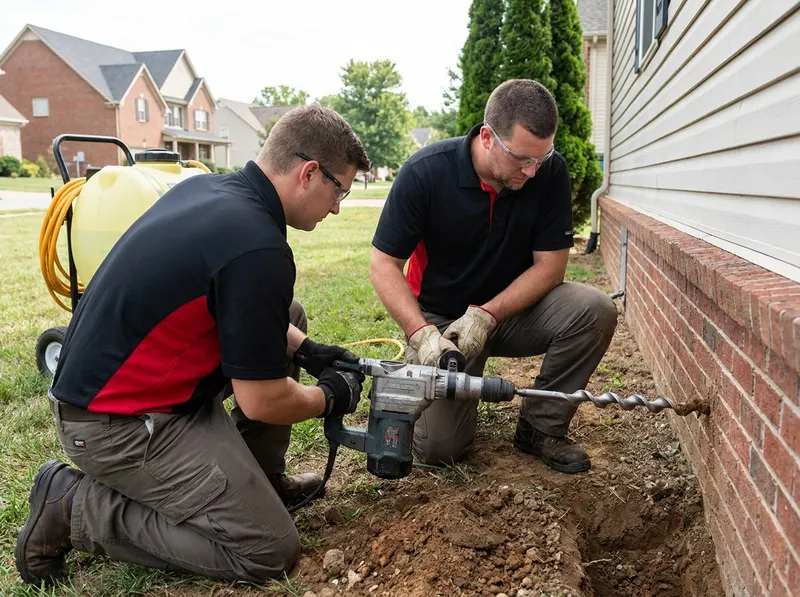
Subterranean termite treatment in Nashville addresses the specific vulnerability of regional architecture, where high humidity along the Cumberland River basin accelerates wood rot and subterranean activity. Properties in East Nashville, Sylvan Park, and Belmont-Hillsboro frequently rest on crawl spaces with fieldstone or hollow concrete-block foundations. In these structures, subterranean workers build mud tubes from damp clay soils up masonry piers to feed on floor joists. According to structural guidelines from the U.S. Department of Housing and Urban Development, establishing an uninterrupted chemical barrier or baiting zone along foundation footings is required to halt continuous structural degradation.
Treatment selection depends directly on foundation engineering and soil composition across Davidson County. Continuous liquid barrier treatments utilize non-repellent termiticides such as fipronil, which workers traverse without detection and transfer back to the reproductive queen. Ground application requires trenching 6 inches wide and 6 inches deep around foundation stems, following the United States Environmental Protection Agency safety standards for termiticide label rates. Concrete slabs, common in slab-on-grade additions throughout The Nations, Donelson, and Antioch, require vertical drilling through expansion joints spaced every 12 inches to saturate sub-slab soils. The Tennessee Department of Agriculture regulates structural commercial pesticide applications to verify proper depth and barrier integrity. For properties bordering natural water tables near Percy Warner Park or Radnor Lake State Park, localized monitoring stations established per USDA Agricultural Research Service subterranean protocols provide colony elimination without non-target soil saturation.
Property managers and homeowners face a definitive choice between non-repellent liquid barriers and localized in-ground baiting arrays. Liquid barriers provide immediate structural isolation within 24 hours, saturating the perimeter so foraging workers cannot enter framing, though the process involves drilling finished porches and masonry patios. In contrast, baiting stations eliminate the subterranean nest over 60 to 90 days using chitin synthesis inhibitors per standards set by the National Pest Management Association, avoiding interior slab drilling at the trade-off of a slower initial knockdown. The University of Tennessee Extension notes that swarming activity spikes between March and May following seasonal rainfall. Integrating environmental moisture control, crawl space vapor barriers, and gutter rerouting aligns with the Centers for Disease Control and Prevention criteria for structural dampness mitigation.
Proper application follows a strict sequence: 1. CanyonWisp Pest Response completes a full moisture and sounding inspection of crawl space timbers and band sills. 2. Technicians dig perimeter trenches along exterior stems and rod active entry points along load-bearing piers. 3. Sub-slab injection ports are sealed with non-shrink hydraulic cement according to ASTM International standards for masonry restoration. 4. Tamper-resistant monitoring stations are positioned along exterior drip lines at 10-foot intervals per National Institute of Standards and Technology dimensional guidelines. 5. Technicians verify ventilation clearance under Occupational Safety and Health Administration crawl space entry protocols. For scheduling and structural barrier evaluations, call (629) 319-7822.
Every job gets a firm, written price after a free on-site visit.
Tell us about your subterranean termite treatment job in Nashville and we'll send a clear, written quote, usually the same day.
 CanyonWisp Pest Response